Design goal
Make understanding and manipulating hidden systems feel like an adventure.
Intended audience
Players drawn to environmental puzzles, exploration, and mysteries solved through experimentation.
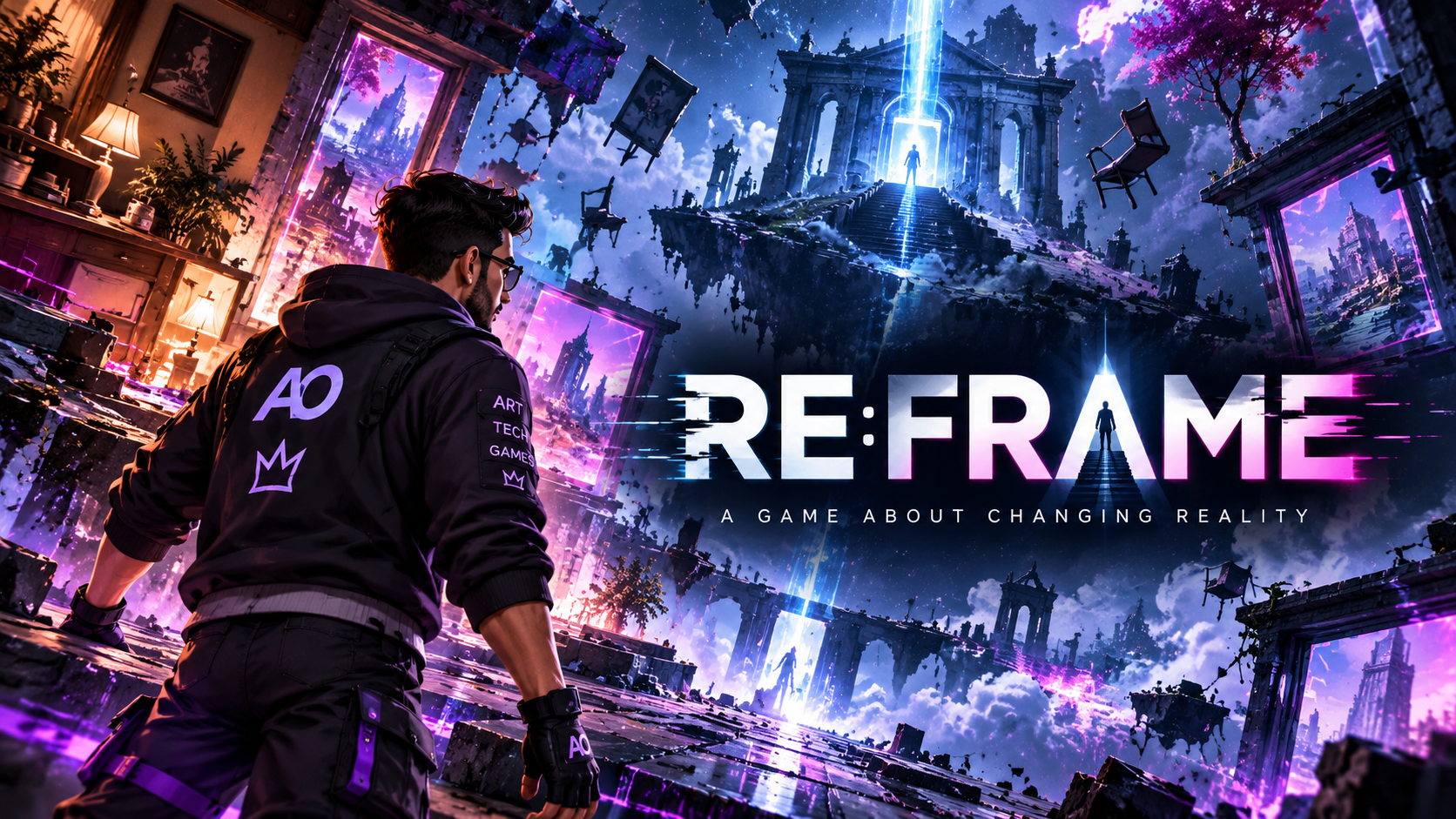
CONCEPT STUDY / Technical abilities & environmental puzzles
Understand a world that appears impossible, then learn how to influence it.
Design goalMake understanding and manipulating hidden systems feel like an adventure.
01 / PROJECT SNAPSHOT
A single-player third-person action-adventure where Ahmed is pulled into a mysterious world connected to the FRAME experiment and uses technical abilities such as Inspect, Debug, Rewire, Simulate, and Rebuild to explore, traverse, solve environmental puzzles, and uncover the world's true nature.
Make understanding and manipulating hidden systems feel like an adventure.
Players drawn to environmental puzzles, exploration, and mysteries solved through experimentation.
How can technical abilities become readable physical interactions without requiring technical vocabulary?
Understand a world that appears impossible, then learn how to influence it.
02 / CORE GAMEPLAY LOOP
Concept loop: the next challenge returns the player to observation and a new decision.
03 / SYSTEM DESIGN
Design intent and rules to validate in a prototype.
Reveal hidden traces and relationships so players can form a hypothesis about an obstacle.
The first glasses interaction exposes a connection that can open a route. Diagnosis supports the current Debug concept.
The reveal should clarify a problem without automatically giving away its solution.
Change a relationship between world elements to alter a route or encounter.
The GDD proposes connections such as door/control, light/source, and machine/target. Exact interaction rules need a prototype.
Communicate valid targets, invalid actions, and resulting world changes clearly.
Expand what Ahmed can understand and influence through equipment earned during the journey.
Glasses precede the glove, pack, and drone. Simulate influences phenomena; Rebuild is reserved for major transformations.
Introduce abilities gradually so later tools deepen exploration rather than overwhelm it.
04 / VISUAL DIRECTION
Concept visuals communicate the intended experience; they are not evidence of a finished playable build.
05 / DEVELOPMENT & VALIDATION
A planned 10–15 minute slice: Ahmed’s room, the FRAME anomaly, arrival, the workshop, glasses discovery, one Inspect interaction, and a small encounter.
Observe whether a player can explain the first puzzle without Technical Art terminology and still enjoys exploration before acquiring the glasses.
Build one greybox puzzle, document its interaction states, and capture a before-and-after playtest revision. The current concept adds Debug; the attached earlier GDD also explores Shader Shift and Optimize.
This case study currently presents concept design and visual material. Playable builds, implementation breakdowns, and measured playtest revisions are not yet included.
06 / DESIGN DOCUMENTATION
GDD v0.1 / earlier ability exploration. The statement above defines the current concept direction.