Design goal
Turn curiosity and historical discovery into hands-on play.
Intended audience
Curious younger players and families, with discoveries that remain meaningful to older players.
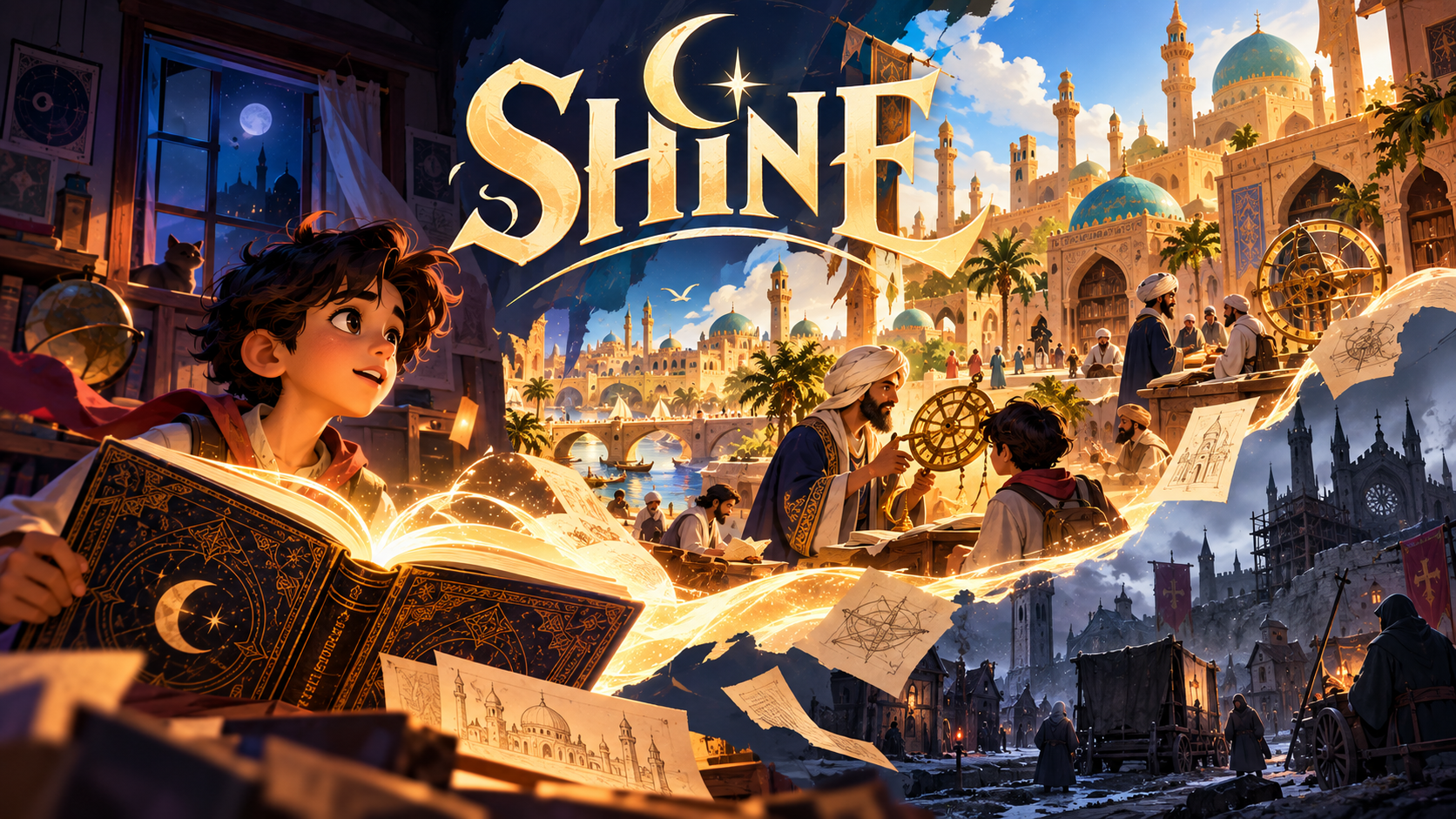
CONCEPT STUDY / Narrative systems & discovery
Walk through history, experiment with its ideas, and bring new understanding home.
Design goalTurn curiosity and historical discovery into hands-on play.
01 / PROJECT SNAPSHOT
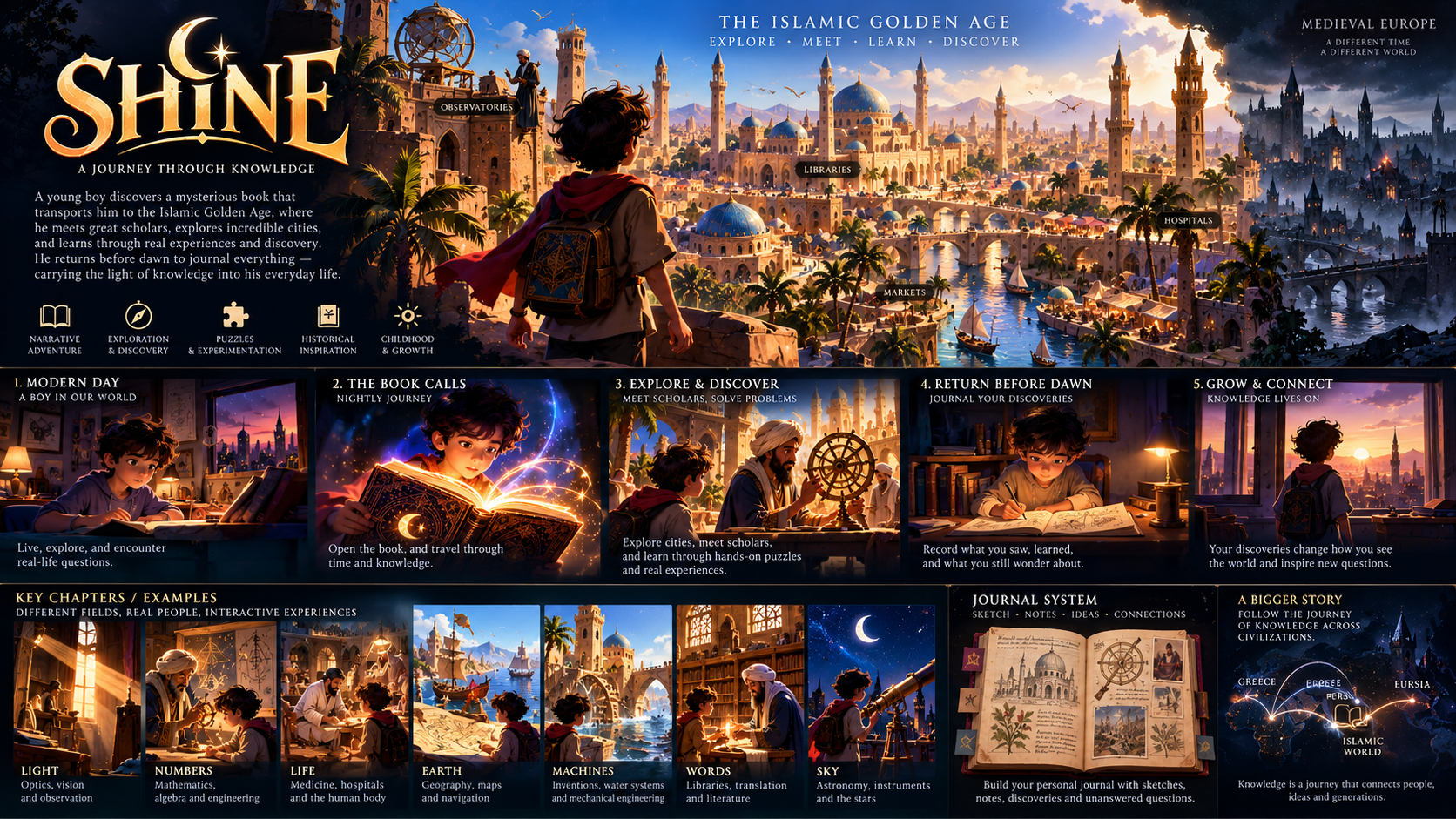
A single-player narrative adventure where a young boy travels through portals from his modern life into different periods of the Islamic Golden Age, meeting scholars, exploring living centers of knowledge, solving discovery-driven challenges, and returning before dawn to record what he has learned.
Turn curiosity and historical discovery into hands-on play.
Curious younger players and families, with discoveries that remain meaningful to older players.
How can learning emerge from the player’s own experiments while the story keeps moving?
Walk through history, experiment with its ideas, and bring new understanding home.
02 / CORE GAMEPLAY LOOP
Concept loop: the next challenge returns the player to observation and a new decision.
03 / SYSTEM DESIGN
Design intent and rules to validate in a prototype.
Encounter a phenomenon before receiving its explanation, then manipulate tools and materials to understand it.
The LIGHT chapter proposes experiments with apertures, light, mirrors, and materials before applying an optics principle.
An incorrect hypothesis should produce a readable result that encourages revision, rather than only a failure mark.
Record observations, interpretations, unanswered questions, and connections to modern life.
Earlier conclusions can receive corrections; discoveries can introduce interaction vocabulary for later chapters.
The journal should communicate personal growth without becoming a compulsory encyclopedia.
Alternate everyday life with historical journeys and a meaningful return.
Visual and audio cues announce dawn; the GDD treats it primarily as narrative pressure, not a mandatory hard timer in every chapter.
Preserve a sense of urgency without punishing careful exploration.
04 / VISUAL DIRECTION
Concept visuals communicate the intended experience; they are not evidence of a finished playable build.
05 / DEVELOPMENT & VALIDATION
One historical discovery chapter, its modern-day setup, a hands-on challenge, and a return-to-journal sequence.
Ask players to solve a discovery challenge and explain the principle in their own words, then observe whether they connect it to the journal entry.
Create a chapter flow, an annotated location layout, and a journal mockup. Validate player guidance and review historical details before expanding the setting.
This case study currently presents concept design and visual material. Playable builds, implementation breakdowns, and measured playtest revisions are not yet included.
06 / DESIGN DOCUMENTATION
Concept GDD v0.1. The statement above defines the current concept direction.